Table of Contents
Fun Facts to Know and Share About Rabbit DQs (I)
This article is in 2 parts because it's kind of long.
The colour DQ section is in Part II. I have included quite a few pictures.

Very often when a competitor is disqualified from something like a sports competition, it is seen as something to be ashamed of.
Not so in rabbit shows!
At least, not usually.
There are many reasons a rabbit can be disqualified (DQ'd) from their class at a show. Only some of them are the result of something nefarious.
That said, many, if not MOST DQ's at shows can be foreseen and avoided. But we all make mistakes sometimes, or forget to check our rabbits carefully enough, so unless you make a habit of not checking your buns before a show, it's not really a big deal. I'm sure there are some, but I don't know a single exhibitor who has never had a rabbit of theirs DQ'd.
A DQ isn't normally a source of shame at a rabbit show. In fact, it can be seen as a terrific learning opportunity. So let's proceed….
What Happens When a Rabbit is DQ'd
First, it is important to note that a DQ is the Judge's call, and many of these are not open to protest.
In many cases, a judge will often ask for a second opinion before disqualifying a rabbit.
Trust the judges. They know what they are doing.
They do NOT want to disqualify any rabbits from competition, but at the same time, they are bound to uphold the ARBA1) standard.
At the end of this article you will find a table of disqualifications, whether it's temporary or permanent, and whether it is (or likely is) genetic. This information can help you decide whether or not to keep this animal (and possibly its relatives) in your breeding program.
When it comes to earning Legs towards your championship or breed points for specialty competition - with TWO exceptions2) - rabbits that have been DQ'd still count in the tallies for entries and exhibitors.
Note: Rabbits that are 'scratched' (i.e. withdrawn before judging of the class begins) do not count towards the entry and exhibitor totals for Legs.
DQs marked with (*) are the Judge's opinion and NOT open to protest. In other words, the Judge's opinion is final.
Different Categories of DQ
 According to the ARBA Standard of Perfection (SoP), there are several categories of DQs that apply to all breeds equally. There are also disqualifications that apply to specific breeds. We will only cover the general ones in this article. To find out what DQs are specific to your breed, please check the official standard for that breed.
General
The general DQ categories are as follows. Those that are not open to protest are marked with a (*). “Not Open to Protest” means that this is strictly up to the judge's opinion and cannot be argued with.
- Abnormalities(*) - This includes anything that clearly deviates from the normally accepted condition of the body. Ill health falls under this category.
- Altering Appearance(*) - THIS IS A VERY SERIOUS ONE
Dying, plucking, trimming, clipping fur, coloring toenails, etc. Anything done to fake the normal and natural appearance of the rabbit falls under this category. This also includes spraying grooming preparations into the fur.
Brushing, rubbing with a towel to remove dead hair, and spraying with plain water is NOT included. - Genitalia(*) -
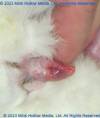 Split penis in males or neutered animals of either sex. You may need to look carefully to check for split penis as the split is almost always along the underside of the penis.
Senior bucks must show two normally descended testicles at the time of judging. Juniors and Pre-Juniors must either have both or no testicles descended. Monorchism (one descended testicle) is a disqualification in all bucks. - Overweight or Underweight - While animals on the borderline may sometimes lose or gain enough weight to be DQ'd in the time between leaving for the show and actually being judged, it's always a good idea to weigh your rabbits before packing them up for the show.
Know what the weight ranges are for each of the classes in your breed.
Most Junior and Intermediate Classes have upper weight limits. If your rabbit is in that age category, BUT is bigger than the upper weight limit, it should be moved into the next category. This can not be done in reverse. In other words if you have a senior rabbit that does not make senior weight, it can NOT be moved down to a younger age class. - Permanent Ear Mark(*) All rabbits entered in a show must have a permanent, legible tattoo in the left ear. If the tattoo is illegible, wrong, or missing, the rabbit must be DQ'd. Tattoos may ONLY contain the letters A-Z and the digits 0-9. They may not be profane.
Most shows will have one or more people willing to tattoo your rabbit if you find yourself at the show and forgot to get this done. - Wrong Sex, Breed, Group, or Variety It happens. Typos while doing your entries; mis-identification; the infamous “Sex-Change Fairy”3)
This DQ affects the total entry and exhibitor counts.

Ailments
Rabbits that are being shown should be healthy and in good condition.
- Abnormal Eye Discharge(*) If it looks like it has an infection, keep it at home until it's completely cleared up.
 Colds(*) - Any kind of nasal discharge other than a clear watery one is grounds for a DQ. This DQ is taken very seriously as it could be a sign of something contagious. If your animal is DQd for nasal discharge, try to remove it from the show building as soon as possible.
A simple clear, runny nose is not considered a DQ.- Conjunctivitis(*) - An inflammation of the inner eye membrane making the eye appear red. This may also indicate a contagious ailment and the rabbit should be removed from the show grounds as soon as possible.
- General(*) - Ear canker, slobbers, vent disease, or abscesses. Mangy fur or flakey, scaley dandruff or bare patches could indicate external parasites and will result in the rabbit being disqualified. These too could indicate something contagious, so please remove your rabbit from the show as soon as you can. (Keep it covered and under your table until you can remove it from the building.)
- Rupture or Hernia(*) Any protrusion in the abdominal wall could be a hernia. These are often, but not always found in the umbilical area.
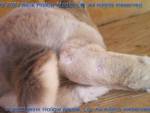 Sore Hocks - If the foot (front or rear) is showing signs of infection or if they are bleeding, the rabbit will be disqualified. Simple bare or calloused skin is not a DQ.
- Tumor or Abnormal Swelling(*) - Any swollen or distended mass that forms a lump will result in a DQ.


Structural DQs

 Crooked Legs(*) Rabbits are meant to have strong legs where the toes point forwards when the animal is relaxed.
Legs that are bowed, bent, splayed, deformed, or cow-hocked may be disqualified if in the judge's opinion it is severe.

 Deviated or Hooked Spine(*) Note the image of the skeleton shown above. Any serious deviation from that curvature is considered abnormal and, if severe enough, would be disqualified.
A hooked spine is one where the neck/upper spine makes a kind of 'S-shape between the head and the ribs.
A hooked spine can sometimes result from too much attention paid on “short” shoulders.
A deviated spine is one that is not straight when seen from above.

 Dewlap(*) Does often develop a dewlap, which is a flap of skin under their chins. Some breeds do NOT allow an obvious dewlap. Check your breed standard to see if it is allowed in your breed.

 Ears(*) Many breeds have specific requirements for how long the ears should be and how they are carried. Lopped breeds with upright ears would be a disqualification in a senior. Alternately, lopped ears in a breed that normally carries their ears upright is also a DQ. The picture to the right is a black Rex junior, who may be cute, but is definitely a DQ on the judge's table.
Ears that are torn, or that have a portion missing must noticeably detract from the general appearance of the animal. In breeds where the length of the ear is specified, it must be possible to measure that length, so if both ears are missing the tips, this could be a DQ.

- Eyes(*)

 Infections of the eyes are covered under Ailments. Diseases such as cataracts are covered here. Cataracts, eye spots, visible ulceration or other corneal (surface) defects, glaucoma, and tumours are all possible DQs, if too noticeable. There is at least one kind of juvenile cataract that is the result of a recessive gene. These cataracts normally do not show up until the animal is 16 weeks old, so they will typically look normal when sold. In other words, the person who sold it to you may not be aware of the issue. Since this is the result of a single recessive gene, it means that BOTH parents carry the gene. This is one that is likely worth noting and tracking back in the pedigree. Test-breeding, while time consuming may be the only way to identify other carriers so they can be eliminated from the gene pool.
Any eye colour other than the one called for in the standard is grounds for a DQ.
Note the 2 pictures of the same tri doe who shows corneal scarring. In the one picture she is younger and in the second picture she is older.
The scarring became much less noticeable as she grew up.
 Corneal scarring can happen any time as a result of an accident but most often occurs in the nestbox as the kits are starting to open their eyes. Making sure the nest box stays clean and not too dusty can help to avoid this problem.
DQs also include marbled (unless expressly allowed in your breed), mismatched, two or more distinct pigments in one eye.


- Pigeon Breast(*) Imagine a pigeon puffing out its breast.
In a rabbit, it is an abnormally narrow chest with a prominently protruding 'V' shaped breastbone.
- Tail(*)

 The tail is an extension of the spine and should follow naturally. A tail that is permanently skewed to one side, or permanently out of line with the spine could be a DQ. A screw-tail (pictured) is one that is twisted instead of straight (like a cork-screw). Broken tails, missing tails, or anything that prevents the judge from assessing the length and shape of the tail will be a DQ. A “dead” tail (i.e. one with no flesh or apparent circulation) is NOT a DQ unless it is broken or out of alignment.
Bob (short) tails are only a problem if they are out of proportion with the rest of the animal.


- Teeth(*)
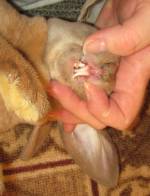
 Teeth may not be broken, missing, or crooked.
Malocclusion is when the front teeth don't meet correctly and is a DQ.
The top teeth must (slightly) overlap the bottom teeth to be acceptable.


- Toenails(*)

 ALL toenails must be present AND their colour must match the the colour of the feet. Mismatched toenails on any one foot are a DQ, as are toenails that do not match on corresponding (i.e. both front or both back) feet. White toenails are a DQ in ALL coloured rabbits - including Californian and Himalayan colours. Coloured toenails are a DQ in white rabbits. Broken colours should have toenails that match the colour of the toe.
A broken toenail is only a problem if the colour of the nail can not be determined.
By the way, it is considered polite (and respectful of the judge) to make sure the toenails on all your rabbits are recently trimmed and not too long or sharp.


Unworthy of Award (*)
Normally, all rabbits in any given Class will be awarded a placement from First to Last. Occasionally a rabbit will be entered that deviates from the general requirements or specific breed standard to such an extent that can not even be awarded last place. In that case, the judge may assess it it as “Unworthy of Award”.
If an animal is deemed to be older than the category in which it was entered (such as if you entered a 1 year old rabbit in a junior class) it may also be unworthy of an award.
Animals disqualified for this reason are not counted in the tallies.
This DQ affects the total entry and exhibitor counts.
Vicious Animal (*)
Any animal that is vicious or uncontrollable may be excused from judging at any time during a show. If it has already won awards, it may keep them, but it may not continue in the competition for the remainder of that show.
SERIOUS DQ's
This last category is the rarest of them all. It involves some sort of attempt to misrepresent the rabbit by altering it in some way. If you are caught trying one of these tricks, you will not only have your rabbit disqualified from the one show, but you might have all of your entries disqualified, and further consequences might follow.
Altering the Rabbit's natural appearance in any way will result in disqualification and may ALSO involve the disqualification of the exhibitor's entire entry for that show.
Permanent / Temporary / Genetic DQs (Summary)
Knowing whether or not a particular DQ is a permanent condition or one that may change over time has an impact on whether or not its show career is over, whether or not you should keep this animal in your breeding program, and possibly even whether or not you should consider removing related rabbits from your breeding program.
PLEASE understand that there is no such thing as the perfect rabbit, so having a permanent disqualifying fault does not automatically mean the rabbit should be culled. It DOES mean that you must decide if this fault is something you can work with or if it is something you would rather just avoid.
Some DQ are genetic and therefor likely to be passed on to offspring. Some are suspected to be genetic, but it hasn't been proven. Some are congenital - which means they were born with it, and it may be a permanent condition, but it will NOT be passed on to their offspring.
Other DQ's are considered temporary. A perfect example is weight. An underweight young senior may still make weight if given time. Whether you are OK with an animal that is slow to mature is up to you. Normally, being slow to reach adult weight is NOT a good thing in a meat breed, but could be perfectly fine in a pet breed. If the animal is overweight, it may simply be because it is fat and putting it on a diet or giving it more exercise might fix the problem.
The chart below lists the DQ's and notes whether they would normally be considered permanent or temporary, and whether or not they are likely to be genetic. Please read this with common sense in mind. Size is definitely a genetic quality, but at the same time being a little bit over or under could simply be a matter of feeding and exercise.
Another thing to remember is that just because it's genetic does not always mean it is the result of a single gene. Many conditions are the result of multiple genes acting together. If that is the case, tracking down the source may be next to impossible. All animals have good and bad qualities that are genetic. It's up to you which ones you are prepared to live and work with.
Please note that this list is not comprehensive. Hopefully, there are enough examples to give people the general idea of how this works. Also, if you disagree with any of the classifications below, please email me so we can discuss it. If you do, please be prepared to provide references for your claim. Thanks!
| DQ | Sub-Category | Permanent/Temporary | Genetic / Congenital |
|---|---|---|---|
| GENERAL | |||
| Abnormalities | General Deviations | either/both | either/both |
| Altering Appearance | Anything YOU do to change their appearance. | Often TEMP | Neither |
| Genitalia | Split Penis | Perm | Likely Genetic4) |
| Genitalia | Neutered | PERM | Not Genetic |
| Genitalia | Monorchid | Often Perm | Could be Genetic |
| Genitalia | Cryptorchid | Perm except in Juniors | Could be Genetic |
| Weight | See note above table | Possibly TEMP | Could be either5) |
| Ear Mark | Bad/Missing Tattoo | TEMP6) | neither |
| Wrong Sex, Breed, Group, Variety | exhibitor error | TEMP | neither |
| DQ | Sub-Category | Permanent/Temporary | Genetic / Congenital |
|---|---|---|---|
| AILMENTS | |||
| Eye Discharge | TEMP | Not Genetic7) | |
| Colds | TEMP | Not Genetic8) | |
| Conjunctivitis | TEMP | Not Genetic9) | |
| Injuries, vent disease, abscesses, etc. | TEMP10) | Not Genetic11) | |
| Hernia | PERM12) | probably not genetic | |
| Sore Hocks | TEMP13) | depends14) | |
| Tumours | TEMP(Surgery will make them not showable) | Predisposition could be genetic. | |
| DQ | Sub-Category | Permanent/Temporary | Genetic / Congenital |
|---|---|---|---|
| STRUCTURAL | |||
| Crooked Legs | bent, bowed | PERM | could be either genetic or nutritional |
| Crooked Legs | splayed | usually PERM | can be a result of a too slippery surface in the nestbox |
| Crooked Legs | cow hocks | PERM | Genetic - usually indicates pinched/narrow hip bones |
| Crooked Legs | from injury | PERM | Not genetic, but still a DQ |
| Deviated or Hooked Spine | PERM | genetic | |
| Dewlap | PERM (in does) | genetic | |
| Ears | length | PERM once grown | genetic15) |
| Ears | lop | Usually Permanent16) | Genetic (except when stress-related) |
| Eyes | Cataracts | PERM | Genetic17) |
| Eyes | Ulceration | Can be Temp | Not Genetic18) |
| Eyes | Miss-Coloured | PERM | Genetic |
| Pigeon Breast | PERM | Genetic | |
| Tail | Wry, Screw | PERM | Genetic |
| Tail | Broken | PERM | not genetic |
| Tail | Dead | PERM | not genetic |
| Tail | Bob | PERM | not genetic if the result of it breaking off |
| Teeth | Broken | possibly permanent depending on severity, can result in lifelong problems if they don't grow back properly. | not genetic |
| Teeth | Malocclusion | normally permanent | usually genetic |
| Toenails | Missing | PERM | not genetic |
| Toenails | Broken | TEMP | not genetic |
| Toenails | Mismatched | usually PERM, often worsens with age | genetic |